




Cadence vs. Torque Sensors: Which E-Bike Pedal Assist Actually Feels Better?
A cadence sensor only knows one thing: are your pedals turning? A torque sensor knows something far more useful: how hard you're pushing. That single difference changes how an e-bike feels, how far it goes on a charge, and how much it costs.
Here's the short answer. A cadence sensor detects that you're pedaling and delivers a fixed amount of motor power for whatever assist level you've selected, regardless of how hard you're actually working. A torque sensor reads the force on the pedals in real time (some systems measure it over a thousand times a second) and scales the motor's output to match your effort. Torque sensors feel smoother and more natural and tend to be easier on your battery. Cadence sensors are simpler and cheaper to build, which is why they show up mostly on entry-level e-bikes.
Today, every e-bike we sell at Scooteretti runs a torque-sensing Bosch drive system, so we've spent well over a decade watching riders feel this difference on their very first pedal stroke. Starting in 2027, we'll also carry Bosch's Hub Line, a cadence-based system good enough that it earns its own exception further down this page. Here's what's actually happening under your feet, without the jargon.
What's Actually Different Between the Two Sensors?
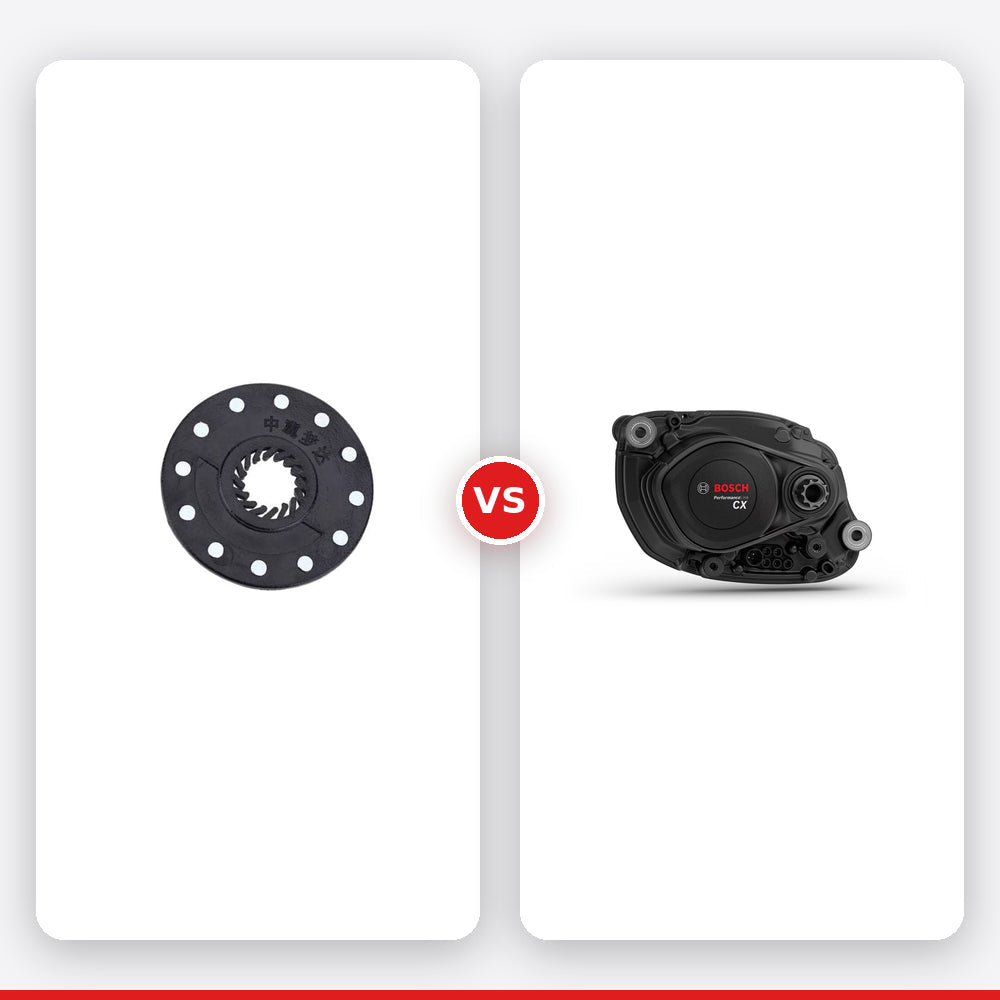
A cadence sensor is usually a small magnet ring mounted on the crank next to a stationary reader. When the crank turns, the reader counts it and tells the motor to switch on. That's it. The sensor can't tell whether you're spinning the pedals with one finger or standing up and grinding your full body weight into them. So the motor just delivers whatever fixed amount of power your chosen assist level (1 through 5, typically) is set to, until you stop pedaling and it switches off.

A torque sensor is a strain gauge built into the bottom bracket or rear hub. It physically measures how much force you're putting through the pedals, usually in newton-metres, and reports that back many times per second. The motor then adds power in proportion to your effort: push gently and you get a gentle boost, push hard up a hill and the motor matches it instantly.
Are All Torque Sensors Built the Same?
No, and this is the part most spec sheets gloss over. "Torque sensor" gets used for two genuinely different designs, and they don't ride the same.
On a true mid-drive system (Bosch, Shimano, Brose, Yamaha), the torque sensor is built directly into the motor unit at the bottom bracket. It measures your pedal force and the motor responds in the very same housing, with nothing in between. That tight integration is a big part of why these systems feel so instant and human-like.
On many hub-drive e-bikes, though, "torque sensor" means something else: a torque-sensing bottom bracket spindle that replaces your standard bottom bracket, wired to a separate motor built into the rear hub. It's technically still measuring pedal force, so the label isn't false, but the sensor and the motor are two different components made by two different processes, connected by a wire and a controller rather than sharing one integrated unit.

In our service department, we've found that separation matters. These bottom-bracket-plus-hub-motor setups are more prone to a few specific failure points: the connector and wiring between the bottom bracket and the rear hub is fragile and easily damaged, water and road grit can work into the bottom bracket housing and cause corrosion or erratic readings, and the sensor's "zero point" calibration is easy to knock out of alignment (resting a foot on the pedal when the bike powers on is a common culprit). When any of that drifts, riders feel it as hesitation, surging, or a ride that never quite feels like a natural extension of their own legs, even though the spec sheet still says "torque sensor." We see meaningfully more of these repairs come through our shop on that design than on integrated mid-drive units.
How Does This Feel When You're Actually Riding?
This is where the difference stops being a spec sheet detail and starts being something you notice in your legs. With a cadence sensor, the motor tends to feel like an on/off switch: start pedaling and a fixed shove arrives, whether you needed it or not, which can feel sudden or jerky pulling away from a stop sign or in slow-speed traffic. With a torque sensor, power builds and fades with your own effort, so easing off the pedals eases off the motor too. Most riders describe it less like being pushed and more like their own legs got stronger.
The gap is most obvious in two situations: climbing hills, where a torque sensor gives you noticeably more help exactly when you're working hardest, and stop-and-go city riding, where cadence sensors are more prone to that sudden lurch as you pull away.
Do Mid-Drive Motors Really Offer More Torque and Better Durability?
Generally, yes, on both counts. Take Bosch's Performance Line CX, its flagship mid-drive: it produces 85 Nm of torque out of the box and can be tuned up to 120 Nm through a software update in the Bosch Flow app, compared with 45 Nm on the hub-mounted Hub Line motor described above. A mid-drive also pushes its power through your bike's own gears, the same way your legs do, so it can multiply torque for a hill without needing a bigger, heavier motor to do it.
Durability tends to favor mid-drives too, though not in every single respect. Because the motor sits low and central at the bottom bracket rather than out at the rear wheel, it keeps the bike's weight balanced and doesn't load the rear spokes and rim with extra torque the way a hub motor can over years of heavy use. Mid-drive systems from Bosch, Shimano, Brose, and Yamaha also have well over a decade of real-world mileage behind them, and in our service bay, integrated mid-drive units need motor-related repairs far less often than hub-motor systems paired with a separate bottom-bracket sensor. The one tradeoff worth knowing: because a mid-drive's power runs through your chain and cassette, those parts wear a little faster than they would on a hub-driven bike. That's a cheap, routine service item though, not a motor replacement.
Does the Sensor Type Change Your Battery Range?
Yes, and it's one of the most overlooked parts of this comparison. Because a torque sensor only delivers the power you actually need, it wastes far less energy during light-effort riding, like cruising on flat ground or coasting through a gentle downhill. A cadence sensor keeps delivering its fixed output as long as you're pedaling, whether or not you needed that much help.
Real-world testing is never perfectly apples-to-apples since terrain, hills, and stop frequency all matter, but manufacturers and independent reviewers commonly report torque-sensing systems returning roughly 15 to 25 percent more range than cadence-only systems on mixed terrain with the same battery capacity, a gap that widens further on hilly routes. Treat that figure as a useful ballpark, not a guarantee, since your actual mileage depends on hills, cargo, wind, and how often you stop.
Cadence vs. Torque Sensors, at a Glance
| Feature | Cadence Sensor | Torque Sensor |
|---|---|---|
| What it actually measures | Whether the pedals are turning | How much force you're applying to the pedals |
| Power delivery | Fixed output once pedaling starts | Scales smoothly with your effort, in real time |
| Ride feel | Can feel abrupt, especially at low speed | Smooth, natural, like stronger legs |
| Battery efficiency | Uses fixed power regardless of need | Uses only the power you actually need |
| Typical cost to build | Lower | Higher |
| Best for | Flat commutes, casual riders, tighter budgets | Hills, longer commutes, anyone who wants the bike to feel like an extension of their own legs |
This reflects how most cadence and torque systems on the market compare today. Bosch's upcoming Hub Line (see below) is a notable exception on the cadence side.
Our Current Lineup Runs on Bosch Torque Sensors
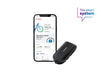
Right now, every e-bike we carry is built around Bosch's mid-drive systems, which use torque sensing as the dominant input (backed up by cadence and speed sensors for extra precision). That's a deliberate choice, not a coincidence. If you want the fuller technical breakdown of how Bosch's system works, we've also written a deeper dive on Bosch's Smart System. Starting in 2027, we'll add Bosch's Hub Line to the lineup too, a cadence-based hub motor we already reviewed favorably, so "torque sensor" won't be the only option on our floor for much longer, just still the smoothest one for hills and longer rides. For now, here are a few places to start browsing:

German-engineered, long-range commuters and touring bikes built for riders who want the smoothest possible power delivery.
Shop Riese & Müller →
Classic Dutch city bikes with a relaxed ride position, ideal for everyday errands and commuting around Ottawa.
Shop Gazelle →
Compact and cargo e-bikes that still deliver full torque-sensing power for hauling kids, groceries, or gear up hills.
Shop Tern →So, Which Should You Choose?
- Mostly flat routes, casual riding, tighter budget: a cadence sensor can be perfectly fine, and it's why entry-level e-bikes are priced the way they are.
- Hills, longer commutes, stop-and-go city traffic, or you just want it to feel natural: a torque sensor is worth the extra cost, and it's the standard on every premium mid-drive system, including Bosch, Shimano, Brose, and Yamaha.
- Not sure what your current bike has? Check the spec sheet for a torque rating in newton-metres (Nm). If all you see is a number of "assist levels" with no torque figure, it's almost certainly cadence-only.
Frequently Asked Questions
Can an e-bike have both a cadence sensor and a torque sensor?
Yes. Premium systems like Bosch's Smart System combine speed, cadence, and torque sensors. Cadence and speed confirm that you're moving and pedaling, while torque does the heavy lifting of deciding exactly how much power to add.
Is a torque sensor worth paying more for?
For most riders, yes, especially if you deal with hills, longer distances, or stop-and-go traffic. The smoother, more efficient ride is one of the main reasons premium e-bikes cost more than entry-level ones.
How do I know which sensor my e-bike has?
Look for a torque rating in newton-metres (Nm) on the spec sheet, that's a torque sensor. If the listing only mentions a number of assist levels with no torque figure, it's a cadence sensor. You can also feel it: pedal very lightly, then very hard. If the power stays exactly the same either way, it's cadence. If it visibly ramps up with your effort, it's torque.
Do all premium e-bikes use torque sensors?
Nearly all of them. Torque sensing is now the standard for mid-drive systems from Bosch, Shimano, Brose, and Yamaha, which is what you'll find on most e-bikes above the entry-level price bracket.
Why do some brands still sell cadence-only e-bikes?
Cadence sensors are simpler and cheaper to manufacture, which keeps the entry price down. They're a reasonable choice for casual, flat-terrain riders on a budget, just not the smoothest option available.
Are cadence sensors always less smooth than torque sensors?
As a rule, yes, but there's a notable exception on the horizon. Bosch's Hub Line, arriving on production bikes in Q1 2027, is a cadence-based system that blends in speed and gradient data to feel far closer to a torque sensor than typical cadence systems do, and it adds an optional throttle for North American riders. It's still the exception rather than the norm. Most cadence sensors on the market today remain noticeably less refined.
Still Not Sure Which One Is Right for You?
Every bike in our Ottawa showroom today runs a Bosch torque sensor, with Bosch's highly optimized Hub Line joining our lineup in 2027. Book a free consultation or test ride and feel the difference for yourself in five minutes.
Book Your Free Test Ride →Free shipping across Canada on orders over $99. Financing available. Every Bosch e-bike we sell is UL 2849 certified.

About the Author
William Leishman
Founder & President, Scooteretti
William Leishman is the Founder and President of Scooteretti, one of Canada's leading electric bicycle retailers and a recognized authority in the eBike industry since 2010. As a member of the National Bicycle Dealers Association (NBDA) Advisory Board for eBike Safety, William plays a central role in shaping best practices and safety standards across North America, and is regularly featured on television, radio, print, and digital media as a trusted voice for consumers and industry professionals alike.
William's core mission is to educate Canadian consumers on choosing the right electric bicycle, one that truly fits their lifestyle, budget, and safety needs. As Canada's eBike market has exploded with new options, too many riders are purchasing the wrong bike, spending thousands across multiple purchases before finding a good fit. Scooteretti's "buy it once, buy it right" philosophy was built to solve exactly this problem, and it has helped thousands of satisfied customers make confident, informed decisions since 2010.
Beyond finding the perfect ride, William is on a personal mission to make eBike safety a national priority. He is a passionate advocate for making UL certification mandatory for every electric bicycle sold in Canada, a standard he believes every Canadian deserves, yet one that current legislation does not require. William is actively working to raise awareness among consumers and at all levels of government, because he firmly believes that no Canadian should have to risk their safety on an uncertified eBike. This isn't just a business position, it's a personal commitment he is dedicated to seeing become law.