






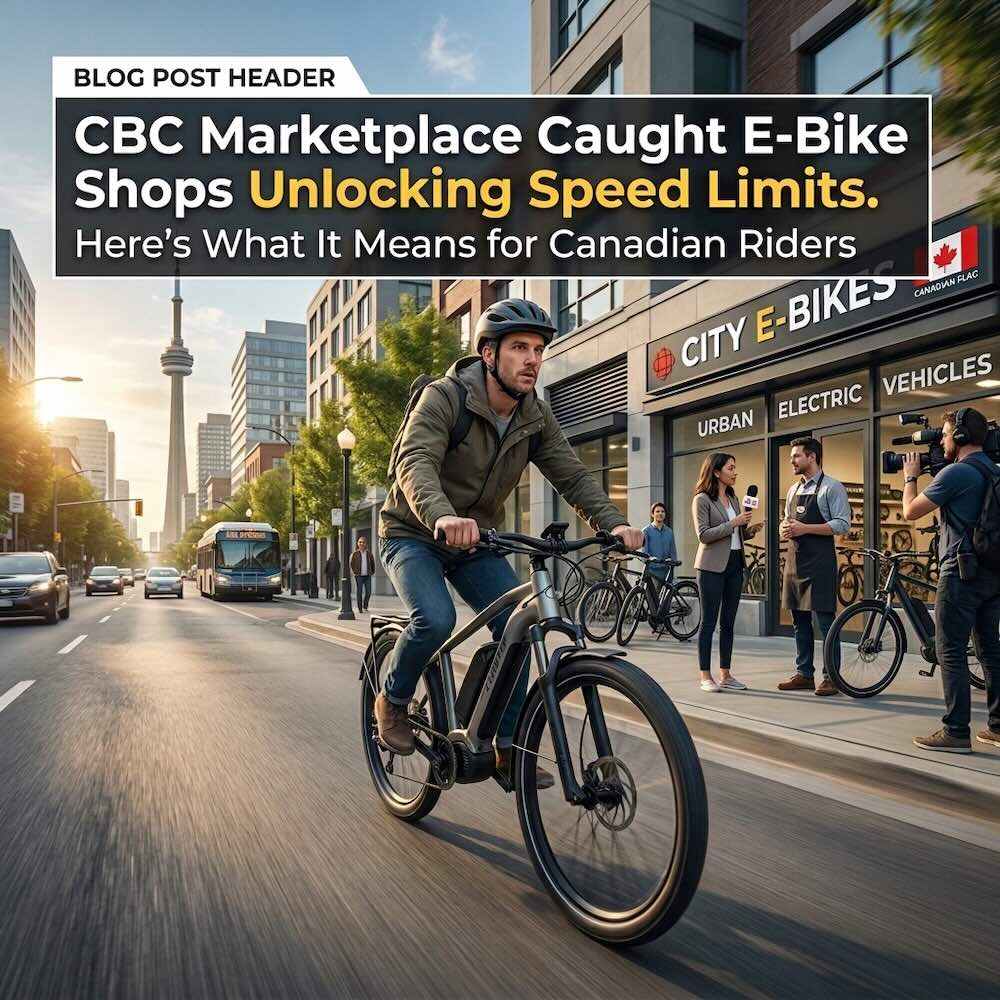
A CBC Marketplace hidden-camera investigation, published October 2, 2026, found that 10 of 12 e-bike and e-scooter stores visited in the Greater Toronto Area sold devices that can go faster than Ontario law allows, and staff at 6 of them showed undercover shoppers how to get around the speed limiter. In one store, a salesperson unlocked an e-bike's 32 km/h limit on camera and said it could now reach about 50 km/h. For riders, an unlocked e-bike is generally no longer a bicycle in law. It becomes an unlicensed, uninsured motor vehicle, with real legal, insurance and warranty consequences.
We have been selling and servicing e-bikes for years, and this report confirms something many of us in the industry already knew. Here is what CBC found, why it matters well beyond Toronto, and how to make sure the e-bike you buy is one you can ride with confidence.
In this article
- What did CBC Marketplace find?
- Why does the CBC report matter?
- Are most e-bike shops doing this?
- Is this just a Toronto problem?
- What happens if you ride an unlocked e-bike?
- What does Scooteretti think of the CBC findings?
- Where does Scooteretti stand?
- How can you tell if a shop is doing it right?
- FAQ
What did CBC Marketplace find?
Marketplace sent undercover journalists with hidden cameras into 12 stores across the GTA, ranging from specialty e-bike shops to big-box retailers. The headline findings from the CBC report:
stores sold e-bikes or e-scooters that exceed Ontario's speed limits
stores showed shoppers how to bypass the speed limiter
the speed one salesperson claimed after unlocking a 32 km/h e-bike on camera
stores stocked products with recommended ages below Ontario's minimum of 16
The investigation also documented e-scooters on sale that could reach 120 km/h, and staff at one store who said a bike could be modified to hit 150 km/h. Ontario's limits are 32 km/h for e-bikes and 24 km/h for e-scooters.
Why does the CBC report matter?

Because the 32 km/h limit is the deal that makes e-bikes work in Canada. It is the reason e-bikes can share bike lanes, pathways and transit racks without a licence, plate or insurance. When shops remove that limit, they are not just selling a faster bike. They are putting that whole arrangement at risk.
The report put the consequences in plain view. Hospital data cited by CBC shows e-scooter hospitalizations for children 15 and under nearly tripled in a year. The Canadian Electric Bicycle Association called the shop practices "heartbreaking," and the federal Transport Minister said Ottawa will consider a role in regulating device safety.
That last point matters to every e-bike rider. Clear, enforced rules are good for everyone. Blunt restrictions that punish legal riders for what a minority of sellers do are not. The best way to protect e-bike access is for the industry to sell bikes the right way, and for riders to know the difference.
Are most e-bike shops doing this?
No. Despite what the CBC Marketplace investigation uncovered, it is important to keep it in perspective. The shops caught on camera represent a small number of retailers, not the e-bike industry as a whole. Most retailers, including traditional bike shops and specialty e-bike stores like Scooteretti, only sell legal products from name-brand manufacturers who respect the law and truly care about their customers.
Those manufacturers build their e-bikes to Canadian rules at the factory, test them to recognized safety standards, and stand behind them with real warranties and dealer support. The retailers who carry them do the same: they set each bike up properly, explain the rules honestly, and keep servicing it for years after the sale.
So if you bought your e-bike from a reputable shop, there is no reason to worry. And if you are shopping for one now, the answer is not to avoid e-bikes. It is to buy from the right place.
Is this just a Toronto problem?
No. Marketplace filmed in the GTA, but unlocked e-bikes and "off-road modes" turn up in Ottawa, Gatineau, Montreal, Vancouver, Calgary and beyond. The rules are close to identical across the country. Ontario, Quebec, British Columbia and Alberta all define a legal e-bike by the same core standard: a motor rated at 500 W continuous or less, assistance that stops at 32 km/h, and working pedals. Change any of those, and the bike stops being an e-bike in law, wherever you ride it.
For the province-by-province details, including age rules, see our guide: Is My E-Bike Legal? A 5-Point Check for Ontario, Quebec, BC and Alberta.

Dutch city and touring e-bikes with smooth, natural assist that never needs unlocking to feel great.
What happens if you ride an unlocked e-bike?
The shop that unlocks the bike walks away. The rider carries the risk. An unlocked or "tuned" e-bike usually means:
| Road-legal e-bike | Unlocked e-bike | |
|---|---|---|
| Legal status | A bicycle in law | Generally treated as a moped or motor vehicle |
| Licence, plate, insurance | Not required | Required, and usually not obtainable |
| Where you can ride | Bike lanes, most pathways, roads | Not permitted on bike lanes or pathways |
| If you crash | Treated like any cyclist | Possible fines and personal liability; in Ontario, riding an uninsured motor vehicle starts at $5,000 |
| Warranty | Full manufacturer coverage | At risk on the drive system and other parts |
| Components | Used within their design limits | Brakes, fork and frame pushed past what they were built for |
What does Scooteretti think of the CBC findings?
We are incredibly disappointed, but not overly surprised. Anyone who works in this industry has heard the stories: bikes "opened up" at the counter, hidden modes switched on before delivery, speed limits treated as a suggestion. Seeing it confirmed on camera is still hard to watch.
Shops that do this are letting down their customers and the entire e-bike community. They are putting riders at legal and financial risk, and they are giving regulators every reason to clamp down on the rest of us. Retailers have a responsibility to respect the law, to respect the people who trust them, and to respect an industry that so many of us have spent years building. We expect better, and riders deserve better.
Let us be clear: shops that cheat the system, sell non-compliant products and deceive consumers have no respect from us, and that behaviour has no place in our industry. It puts riders at risk, it undercuts the honest retailers who play by the rules, and it threatens e-bike access for everyone.
The other half of the answer sits with buyers. Before you spend a few thousand dollars on an e-bike, do your homework. Learn what the rules are in your province, ask the right questions, and buy from a retailer you can trust to give you straight answers. We are proud to say Scooteretti is that retailer: one you can count on to sell you a bike that is legal, safe and fully supported, today and every day you ride it.
Where does Scooteretti stand?
Our policy is simple:
- We will never tune, unlock or de-restrict an e-bike, in the showroom, in service, or on request.
- We will never show a customer how, or sell products designed to do it.
- Every e-bike we sell leaves our shop at its factory power and speed settings.
- We treat a tuned e-bike as what the law says it is: no longer a bicycle.
It is the same position the leading e-bike drive-system makers take, and it is why we carry the brands we do. We want every rider who leaves our shop to ride legally, insured and with full warranty support for years. Read the full commitment in our Road-Legal Promise.
How can you tell if a shop is doing it right?
CBC's findings give every buyer a simple test. Before you buy, ask:
- What is the motor's continuous rated power? It should be 500 W or less. Ignore "peak" figures.
- Where does the assist cut out? It should be 32 km/h, locked from the factory. Better still, test ride it. If the speedometer climbs past 32 km/h while the motor is still assisting, the bike is not legal. 32 km/h means 32 km/h, nothing higher. (Going faster under your own pedal power or downhill is fine; it is the motor that has to stop helping.)
- Will you change the speed limit? The only right answer is no. If a salesperson offers, walk away.
- Is the bike certified? Look for UL 2849 or EN 15194 for the electrical system and battery.
- Who services it and handles the warranty? A shop that will be there after the sale is a shop with a reason to sell it properly.

Premium German e-bikes, engineered and certified for the speeds they are meant to ride, and delivered exactly that way.
Frequently asked questions
What was the CBC Marketplace e-bike investigation?+
A hidden-camera investigation published October 2, 2026, in which CBC Marketplace journalists visited 12 GTA stores. Ten sold e-bikes or e-scooters that exceed Ontario's speed limits, and six showed shoppers how to bypass speed limiters.
Are most e-bike retailers unlocking e-bikes?+
No. The shops caught by CBC Marketplace are a small number of retailers. Most retailers, including traditional bike shops and Scooteretti, only sell legal e-bikes from name-brand manufacturers who respect the law and care about their customers.
Is it illegal to unlock the speed limiter on an e-bike?+
Riding an unlocked e-bike on public roads generally is. Once the motor assists beyond 32 km/h, the bike no longer meets the legal definition of an e-bike in Ontario, Quebec, BC or Alberta, and it would need the licence, registration and insurance of a motor vehicle.
My e-bike was unlocked by the store. What should I do?+
Stop riding it on public roads, bike lanes and pathways, and contact the store that sold it to you to have it restored to the manufacturer's settings. Please note that Scooteretti does not work on any e-bike that is not road legal or that has been unlocked, tuned or manipulated in any way.
Will Scooteretti unlock my e-bike?+
No. We never tune, unlock or de-restrict an e-bike, and we never show customers how.
Can I still pedal faster than 32 km/h on a legal e-bike?+
Yes. The limit applies to the motor's assistance, not to you. The motor simply stops helping above 32 km/h.
Buy an e-bike you never have to worry about
Every e-bike we sell is 100% road legal, from the day it leaves our shop to the day you sell it on.
Shop road-legal e-bikes →Findings summarized from CBC Marketplace's report published October 2, 2026. This article is general information, not legal advice. Rules can change, so check your province's official guidance before you ride. Last reviewed October 2026.